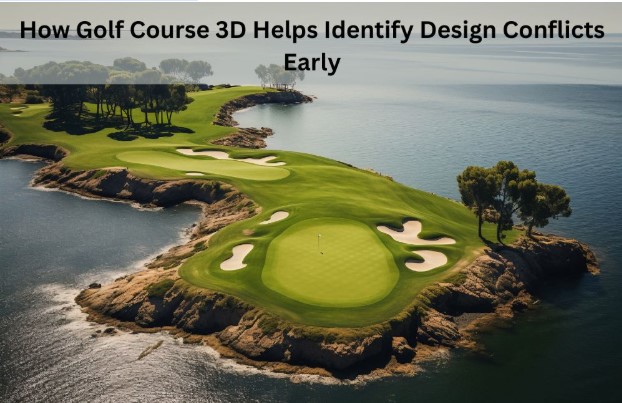

Design conflicts rank among the most prevalent and expensive issues when developing a golf course. Conflicts associated with the land, drainage systems, routing issues, safety measures, and constructability are commonly identified at a late stage – even at the construction phase – when modifications become expensive, and timelines are under threat. Golf course 3D design has emerged as an effective mechanism to identify conflicts at an early stage of the design process.
In a virtual model of the complete course, designers are able to identify discrepancies that are hard to notice while working in a 2D format. By planning in this way, designers are able to make intelligent decisions and avoid costly surprises down the line.
Seeing the Entire Context of the Website Instead of Isolated Pieces
One of the reasons why conflicts often pass unnoticed is the fact that the classic illustration approach involves displaying design components in a standalone manner. The evaluations of the fairway, green, drainage system, and paths are typically reviewed independently of each other.
Golf course 3D enables the designer to see all aspects in the same place on the land. This gives a better insight into overlapping, spacing problems, and mismatches before completing the designs.
Determination of Terrain and Elevation Conflicts
Elevation variation is a key functional aspect when it comes to designing a golf course, though it is not always well-represented graphically when contour lines alone must suffice. Some hills may look gentle when considered graphically, though they may not be safe or even feasible to maintain when it comes to mowing, or even when it is a question of drainage.
By working in three dimensions, designers are able to see where the features lie on the land.
Early Detection of Drainage and Water Flow Problems
Poor drainage is among those conditions that are most costly to rectify once construction has commenced. Water-related disputes are often driven by subtle contours that are difficult to interpret two-dimensionally.
Water movement becomes easier to interpret with three-dimensional imaging. The designers can see low points, drainage, and where the water may collect. Thus, drainage systems can be made to interact favourably, before any conflict exists between the areas of turf, the bunker, and the natural drainage.
Routing and Circulation Issues Resolution
A golf course routing has to consider playability, safety, and efficiency. Conflicts of design occur particularly where there are intervisible or intersecting holes, or where there are difficult transitions between holes.
A golf course 3D model assists the ground planner in tracing the routing paths and understanding player movement through the ground intellectually. Conflicting areas like intersecting fairways, blind landing areas, and transition areas, which might cause conflicts, are identified by visualizing the golf course realistically.
Preventing Safety and Visibility Conflicts
Safety factors significantly influence golf course design. Lack of visibility among tees, fairways, and greens poses a risk to golfers.
In this way, by observing the sight lines in three-dimensional views, it will be easy to point out locations where the players will find errant shots. On this basis, changes will then be made to facilitate the adjustment of the tees, fairway, or natural buffers.
Aligning Design Intent with Feasibility of Construction
Some design conflicts remain latent until construction crews start implementing them. The design may include elements that are acceptable and aesthetically pleasing on drawings, although hard to implement in practice through grading limitations and access difficulties.
A 3D model of a golf course can thus go a long way in filling the gap between design and construction by allowing one to visualize how these elements will be constructed on the ground.
Enhancing Coordination among Design Disciplines
Golf projects require integration of architects, engineers, environmental specialists, and construction contractors. Disputes are inevitable as each profession uses a separate set of drawings.
Three-dimensional visualization creates a common thread that integrates all the teams. When all the members are able to see the same graphical model, discrepancies are detected and fixed before the project is even started.
Eliminating Costly Revisions and Project Delays
Design issues at a late stage will invariably lead to change orders, increased costs, and schedule compression. Early identification of issues is the best way to master costs and schedules.
Through incorporating 3D golf course models during the initial stages of planning, teams are able to resolve conflicts without having to go through physical conflicts. This is a preventive measure that saves time.
Facilitating Easier Client and Stakeholder Reviews
Clients and stakeholders do not have the necessary expertise to recognize possible design conflicts in conventional plans. Visually based plans are important for discovering issues during the review process.
The use of 3D visuals helps the parties involved grasp the design concept and bring up their concerns early. The results include productive comments and a lack of surprises during the project.
Final Thoughts
Early conflict identification is one of the most important benefits of 3D golf course design. This is because three-dimensional golf course design helps to identify land difficulties, drainage problems, routing conflicts, and safety-related difficulties before starting the golf course construction process.
With an accurate 3D model of your golf course, designers are able to provide perspective in order to coordinate disciplines and press on promptly. With the ever-expected complexity in the project, coupled with demands on efficiency, recognizing possible conflicts in a 3D perspective is not a recommendation—it is a critical success factor in project delivery.